
• Home
• OCSelot
• Contact
• Imprint
deutsch 


|
This text wants to attack and overcome what in my opinion are central flaws in reasoning about language: the notions of ambiguity and contextuality. In my view, the general idea of language and in particular the linguistic sign rests on erroneous assumptions with their regard, assumptions taken over from common-sense, never questioned in their essence, and quite unjustifiedly awarded the reputation of common-places.
I show, how both ambiguity and contextuality are contradictory and in conflict with causality and logic, I explain, how these contradictions are rooted in a deep misunderstanding of the linguistic sign, I move on to revise the sign, include context and give evidence for the materiality of "nothing else", and arrive at a revised notion of the sign as a complete perceptual state.
The sign so determined is free of ambiguity and contextuality, and above all semantically non-compositional. I also give some explanations why the errors are typically made and finally challenge the proposed sign conception from the viewpoint of generativity.
It is odd that the concepts of ambiguity and contextuality
should be generally taken for granted. I will prove how completely nonsensical they are and
postulate a theory of language free of them.
Given this, the concept of ambiguity is contrary to reason, as it implies causal branching:
A single cause (or sign) s is said to bring about more than one effect (or meaning) m, like

and it is said that
For several reasons, this ought to puzzle:
Therefore, when thought to the end, the idea of ambiguity denies cause-effect-relations, or sign-meaning-relations, altogether. And there is more to worry about:
And this is clearly a contradiction against the law of transitivity of equivalence, which
requires d1 to equal d2 if both equal some third object s:
IF s = d1 AND s = d2 THEN d1 = d2
Context appears to be the hidden agent choosing the particular meanings and thus
to avoid the assumption of uncaused effects.
The idea is that sign s in combination with context c1 leads to meaning m1, and
in combination with context c2 to meaning m2:
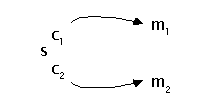
This appears to avoid the impression of causal branching and of meaning as something popping out of a trap. But the appearance deceives:
Accordingly, ambiguity (a sign may have several meanings, each picked out by some context) isn't questioned but lent support, and ambiguity's problems are not in the least overcome!
If something does not by itself produce what is thought to be its effect, it can't be called this effect's cause.
And it does not make a difference if this something is indeed a part of the cause; otherwise, arbitrary tiny fractions of a cause would be held equal to the cause as a whole.
To put it in terms of semantics: to claim that a sign has some meaning in a certain context, is to admit that the thing thought to be a sign is no sign at all!
Thus, contexuality is in no way a solution of the problems but at best a half-hearted
attempt at an escape, along the way producing the pernicious effect of all half truths:
it diverts attention from the problem and generates a false sense of security,
thereby allowing the sin unhindered growth.
In order to avoid the branching from a single word to several meanings, the word is conceived to virtually being several words which only accidentally happen to share the same "surface form".
Rather than having one word w with two meanings m1 and m2, like

a representation in terms of homonymy applies differentiating indices to yield two separate words
with only one meaning each, like

But as beautiful as this may look, and as widespread as this "technique" is and as well-known from dictionaries, it is only a bad trick:
Since the real world contains the un-indexed word only,
some way is required to go from this word to the indexed variants or "virtual words",
and this brings in, only shifted by a step, exactly the same branching
which homonymy was meant to overcome:

In other words, the original ambiguity of w's having two meanings m1 and m2,
pops up again as the ambiguity of w's mapping to two homonyms w1 and w2!
And, of course, nothing is gained.
The above discussion suggests: As ambiguity and contextuality imply causal and logical errors and as these come as consequences of what is assumed to be a sign, this assumption of what a sign is must be false and the conception of a sign must be in need of a revision.
Accordingly, the combinations of s with contexts c1 and c2,
respectively, are taken to be two separate signs s1 and s2,
each having a single meaning:
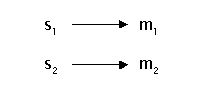
This cleans the picture:
Is it simply all the given text? Yes, maybe. But then: what is text?
Let me point out a phenomenon (using examples from German, with English translations) which shows that the matter is not as trivial as it may seem:
Take
(1) "Hör auf" -- 'Stop'
If certain context is added, the meaning changes radically:
(2) "Hör auf mich" -- 'Follow my advice'
Adding more text can make the meaning twist again:
(3) "Hör auf mich zu ärgern" -- 'Stop bothering me'
And this can even go on for another, albeit somewhat contrived, step:
(4) "Hör auf mich zu ärgern Dich gibt's keinen Grund" -- 'Follow my advice, no need to worry'
How is this to be interpreted with regard to sign constitution?
Rather than set up
"Hör auf"
as an ambiguous expression with several meanings in different contexts, which
has been shown to lead to nonsense, one would include the contexts and call (1) to (4)
separate signs, with
"Hör auf"
a mere part common to them.
The examples show, however, that the inclusion of text is only a first step in the right direction, since each of the stages (2), (3), and (4) contradicts its respective predecessor!
Each of (1) to (3) states a certain sign-meaning-relation and maintains to have represented what is responsible for the particular meaning. And every subsequent stage proves this statement wrong:
If the assumed sign in (1) really had the supposed meaning, it would carry this meaning
along with it, into arbitrary environments. However, (2), of which (1) is an obvious part,
shows that it does not.
And the same goes for the assumed sign in (2) with respect to (3) and the assumed sign in (3) with
respect to (4).
So in each case a statement about the meaning of a certain piece of
text is made and subsequently falsified.
This shows that one does not arrive at a sign by merely including all the given text. There must be something else which so far has been overlooked.
To solve the mystery, let us consider (intensely) the cases of (1) and (2):
If
"Hör auf"
were the sign responsible for the meaning illustrated by 'Stop', this meaning would
accompany it always and without fail.
As occurrences like
(2) "Hör auf mich" -- 'Follow my advice'
show, however, it does not.
Then what, if not
"Hör auf",
led us to make the statement
(1) "Hör auf" -- 'Stop' ?
This "nothing else" is what you see when looking at words which stand alone on an otherwise blank sheet of paper, surrounded by whitespace. It is certainly also something: sections, albeit unstructured, in your field of vision, surrounding something that you focus on.
Consequently, the revised sign looks like this: It is the complete state of affairs in a given field of vision or perceptual horizon.
Brief as this representation is, it should be kept in mind that all signs are of
the same size, determined by the capacity of perception.
Using the previous examples, four signs could look like this
" Hör auf "
" Hör auf mich "
" Hör auf mich zu ärgern "
" Hör auf mich zu ärgern Dich gibt's keinen Grund "
with variations only in content, not size.
It should be noted that the sign's size depends on the size of the perceptual field of the individual. There may be considerable variation in this respect, both between individuals as between conditions of an individual over time. The important point made here is that the sign's size does not vary with what is perceived.
The world writes on the perceptual horizon, modifying the state but not the size (dimension, resolution) of the state space.
The sign, as it could be determined, is free from the old curses, and accordingly semantics is no longer in conflict with the laws of causality and logic.
Disambiguation is defined as the selection of the one meaning (out of several possible) which is appropriate in a given context. Since it could be shown that context as an external force is a non-entity, and what appears to be in this role is actually a genuine part of the sign, whenever disambiguation appears to go on, we have a case of sign-change: the "context" didn't pick a meaning of the sign but it modified the previous sign into another one with another meaning.
Because what is assumed to be the "current meaning of a word" originates in something larger than this word, what we are doing when we assume a case of disambiguation is that we attribute elements of the meaning of a whole to one of its mere parts. This is exactly what has been criticized above under the topic of context dependence: Some entity is actually processed but when it comes to theoretical description, relevant parts of this entity (called "context") are overlooked.
The technical process of semantic tagging shows the error explicitly: there, insights are gathered by exploring complete sentences and even texts but then the results are distinctively tagged to words and phrases.
Therefore, if differences in interpretation yield different meanings, this is because every interpretation makes for a distinct sign.
My attack at ambiguity is targeted at proper ambiguity alone, systematic ambiguity, which comes with causal branching and logical contradictions. Since this could be shown not to exist, what I called ambiguity of "ambiguity" is better named multiway-interpretability of "ambiguity".
"break" is the same whereever it occurs. To attribute it a part-of-speech label like "V" or "N" suggests as a property of the word "break" what actually is at best a property of the whole sentence.
It may be worth noting that the quality of atomicity, if applicable, does not only apply to the text to be described, but to the describing text as well...
The answer is: it is informationally more. To know that there is only one person in a room, is to know more than only to know that one person is in the room. The latter leaves the number of people open: there may be one or five or a hundred.
This answers to the question somebody might ask: if I want to represent a word in isolation, why is it not enough to write this word (and nothing else)? Well, because the isolation is not contained in the word, it is not a property of it. You have to explicitly represent this nothing else, in short:
If you want to write only a word, you must do more than only write a word!
In order to make out an object "as isolated", we look at its environment. To be alone is not a property of an object. It is the property of a space containing nothing apart from the object.
If asked to write only a word, the normal reaction would be to write a word and refrain from writing any more. This refraining isn't enough, however, there must be positive action to express the only-ness: you have to make sure that there is only the word visible to the recipient. The recipient's horizon must be larger than the single word and you must take care that nothing enters it apart from the one, particular word.
Imagine somebody asked you to paint a person as one of a group of five people. And then to paint an isolated person. How would you express the difference?
To perceive the word, a reader must perceive the form of this boundary and to do this he must see both the black and the white regions. Therefore, the "background" is no less important as the "foreground", and the misleading distinction should be given up. The black parts of a word may for secondary reasons seem in the foreground, e.g. because we know that in printing black ink is applied to white paper, but semantically (causally) the two colors (shades) are on the same level.
Accordingly, to point to a word in a black-on-white text you have to point to a rectangle or an oval which contains black forms and white forms. So, the two words "book" and "have", although differing internally in terms of the forms of their black and white regions, may well have the same outward shape!
Having made this step, take the next and allow the sign to stretch to the border of the perceptual horizon...
If a sign is the complete state of an input space, it stretches to the border of a field of vision, leaving no space uncovered. Every sign is as large as any sign can get. And this logically prevents the possibility to compose signs from signs and build larger signs from smaller signs.
Note that atomicity does not imply that signs as well as meanings could not be analysed as being composed of pieces. What it merely says, is that the pieces of the two sides are not connected: there is no path leading from a segment of the sign to some corresponding segment of the meaning.
So, there is compositionality, but it is not semantic compositionality.
What is required now is to raise this level considerably. Admittedly, to its extreme, where the sign equals a complete perceptual state.
To put it in the form of a slogan: What looks like the meaning of a part, is in fact a part of the meaning of a non-compositional whole.
There are several "good" reasons for the misapprehension of the linguistic sign. I will give a short account of what the error consists in and then mention a few of its reasons.
There is some cause c for some effect e. c is extended in space and it has internal structure. If for some reason only a part f of c is (mis)taken to be the cause for e, and if secondly f is part of another cause with a totally different effect, then we end up with both ambiguity, since f is paired with different effects (meanings), and contextuality, since extraneous conditions are sought and required to explain why f goes with one rather than another effect.
Accordingly, the remedy is to become conscious of the state bringing about some effect, to see the whole and turn away from its fragments. Linguistically speaking, to become conscious of the holistic nature of the sign.
What is bad about compositionality, is that this assumed need for semantic analyticity
and composition drives and lures us into false assumptions of the sign, introducing ambiguity
and context dependence.
Desirous to find the source of an effect, we try to track down the parts of complex effects
to parts of complex causes. It is counterintuitive at first to accept that the structure of a
cause is unrelated to the structure of its effect.
If we are not aware of what the situation contributes, we tend to overestimate the amount of information that our words convey. I.e., we feel meaning in a word, whereas in reality the whole situation was necessary to bring this meaning about.
Something like this exclusive sensitivity to motion appears to be at work in humans: if a sign is changing into another and if this change is accompanied by a change in the meaning, then we not only readily detect the correlation between these changes but we are prone to take what differs in the texts to be the cause for what differs in the meanings.
As an example take the pair of sentences
"The sun smiles from the sky."
"The sun smiles from the blue sky."
The comparison of the two sentences makes "blue" stick out, and the comparison
of the meanings makes the idea of a certain color stick out.
And from this observation we jump to the "conclusion" that the word "blue" has this
particular meaning.
It is true: by adding and removing something to/from a sign you can switch something
in a meaning on and off.
But it is the addition and the removal which have these effects, not the piece
which is added or removed! The addition of "blue" in the example substitutes a sign
by another sign. And the difference between their meanings is just that and
cannot be traced back to "blue".
The pair of sentences
"He wrote a song"
"He wrote a blue song"
shows how misleading the focus on correlated changes is: in this case it would
lead to an assumption of the meaning of "blue" which would be in contradiction to those
of the previous example.
Other striking evidence comes from minimal pairs like
"port"
"sport"
If from correlated changes in words and meanings one could deduce
sign-meaning-relations, "s" would have to be postulated as having
that as its meaning
what separates the meaning of "#sport#" from the meaning of "#port#".
This reminds one of considerations known from chaos theory or of social phenomena discussed under the name of "tipping point". The beat of the butterfly's wing does not cause the hurricane, it only makes the difference, it completes a conjunction: the world with it leads to the storm, the world without it does not.
The point here is not that the dialog partners are obviously convinced of the
meaningfulness of words and that in this exchange they tacitly strengthen this
assumption. The point is that such a dialog works, and it works even if your views
of language are like those as presented here!
So, why does it work? Because you can go from sign to sign without repeating all that stays in place. You can restrict yourself to uttering only the bits that are changing.
Hence, the above dialog is an abbreviated, partly obscured, version of
"I don't understand 'He wrote a blue song'.
Seems, it has to do with 'blue'.
Can you give me a paraphrase with 'blue' replaced by something I know?"
"It's like 'He wrote a sad song',
'He wrote a melancholic song', or
'He wrote a low down song'"
I know, this is only a first attempt at a convincing answer...
To repeat an observation I made above: The quality of atomicity, if applicable, does not only apply to the text to be described, but to the describing text as well. Whole is paired with whole.
If signs are atomic, how is grammar to be thought? And, most importantly, how can generativity be explained? Doesn't generativity question the idea of an uncompositional sign?
Generativity in production requires that known elements can be composed into a new utterance. And vice versa, generativity in understanding requires that a new utterance can be analyzed into known elements. The sign which I postulate here, appears irreconcilable with this requirement.
Words would be indistinguishable, if they did not each have their individual effect. The distinctive impact is evident for the retina and the topmost level of the visual cortex to which input from the eyes is projected first.
From then onward superimposition and non-linearity set in, with the consequence that elements of the deepest states can not be related to elements of the input. There is no path leading from a segment of the input to a segment of the output and, vice versa, a part of the output can not be traced back to originate in a part of the input. The input-output-relation is not analytic, but atomic.
However: if input elements don't strike all the way through to the output,
this does not mean to say that a segment of the input would not
have its individual contribution to the overall process:
it only means that this contribution can not be expressed in terms of the process' result
First of all: Thanks for having come so far! Now, what do you think?
Did it strike a chord in you? Are you pleased or red with anger?
I'm interested in hearing from you: please send your comments and remarks to
post@tillmann-wegst.de.
Some while ago, I posted a reference to this text to several newsgroups. In particular, the discussion in the 'comp.ai.nat-lang'-thread A revision of the linguistic sign is, I believe, a lively read.
The core of the views presented here go back to work I began as a student in the early to middle 1980s and have appeared in print in my German book "Die semantische Einheit", 1988, Peter Lang Verlag. The first three chapters of it can be read here.